
Because breast health is about more than screening.
You’ve done everything right.
You show up for your annual screening. You perform self-exams. You follow the recommendations.
And yet something still feels uncertain.
Maybe you received a dense tissue result with no clear next step. Maybe you’ve had a scan that came back “normal” — but you still don’t feel like you understand what’s happening in your body. Maybe you’re navigating a new diagnosis, a family history, or simply a growing sense that you want more than a once-a-year answer to a question that matters all year long.
That feeling deserves more than dismissal.
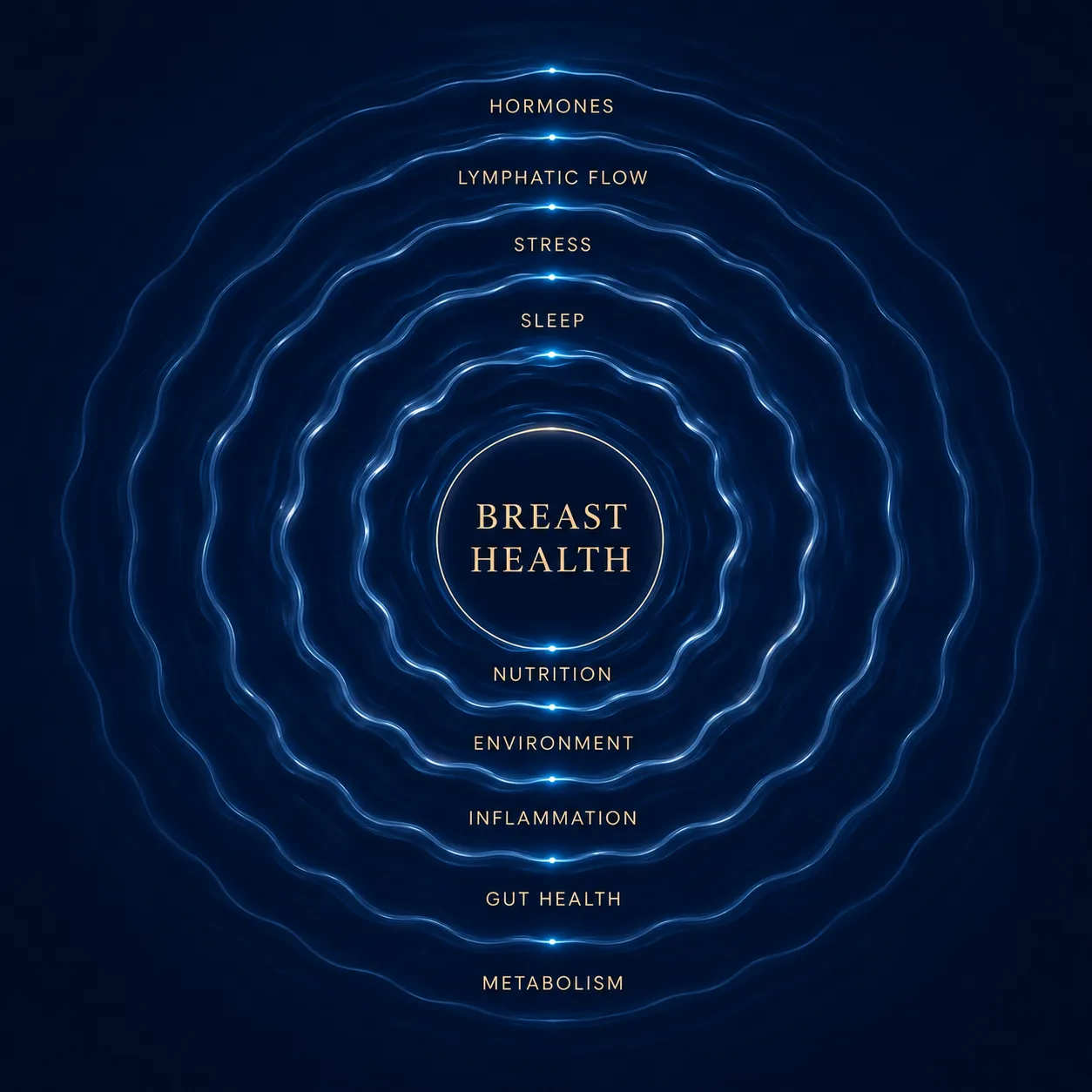
Most women are taught to think about breast health reactively — a screening, a wait, a result. But breast tissue is one of the most dynamic and responsive systems in the body. It changes continuously, shaped by hormones, stress, sleep, nutrition, inflammation, and the health of the body as a whole.
You deserve more than a moment of attention once a year.
You deserve to actually understand what your body is telling you.
Breast tissue doesn’t function in isolation.
It responds constantly to the signals it receives from surrounding systems — hormones, lymphatic flow, stress responses, sleep cycles, nutritional status, inflammatory patterns, and environmental exposures. Each one leaves an imprint. Over time, those influences shape how breast tissue functions, adapts, and changes.
This is why two women can have similar concerns but arrive there through entirely different paths. And why understanding the full picture matters more than focusing on any single finding.
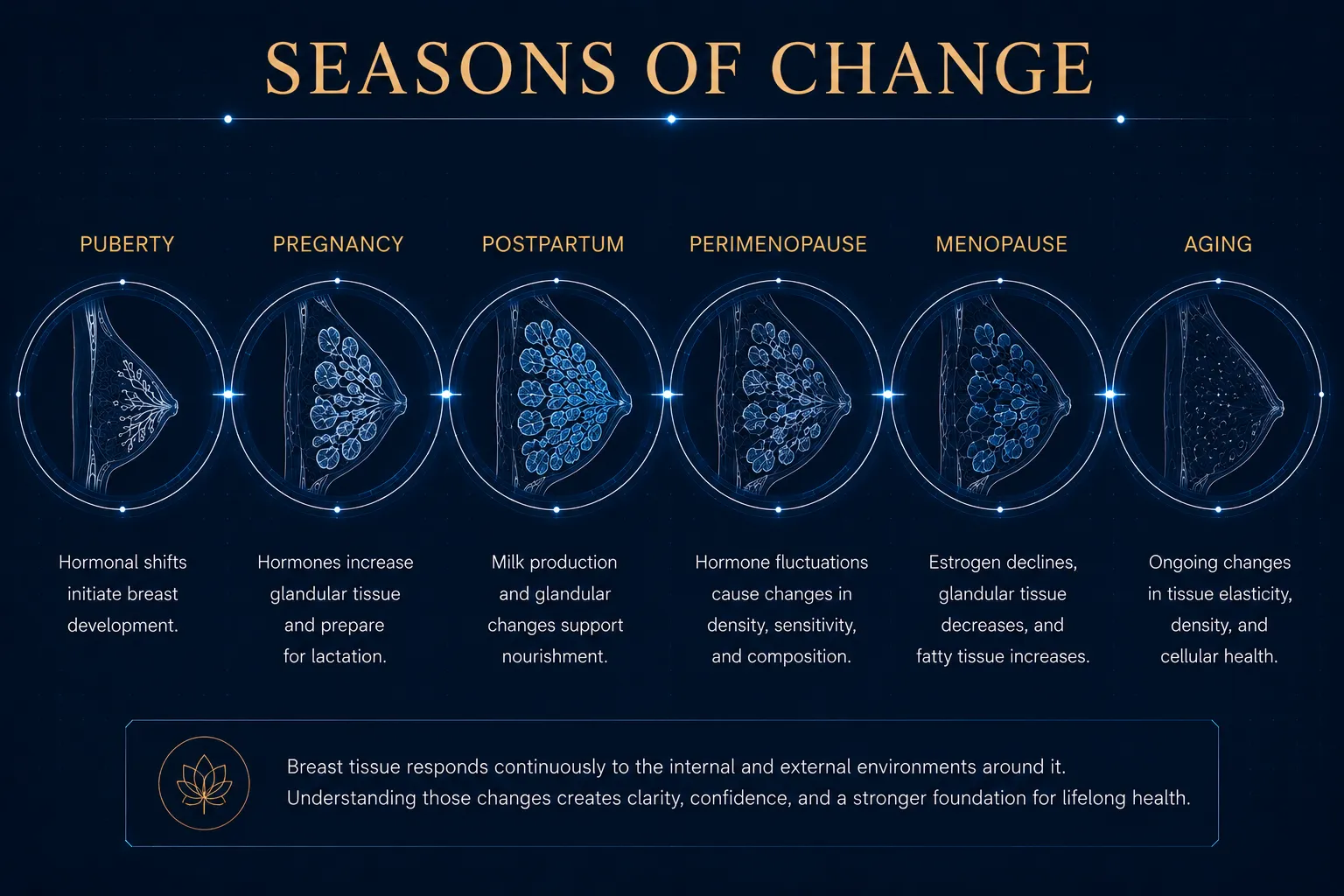
Every change is information.
Breast tissue shifts throughout your entire life — across puberty, pregnancy, postpartum, perimenopause, menopause, and aging. Many of these changes are expected. Some feel confusing. Others go unnoticed entirely. But none of them happen in isolation, and none of them exist outside the context of your whole-body health.
Most women have never been taught about the lymphatic system — despite the fact that it plays a central role in breast health.
Unlike the circulatory system, which has the heart to keep blood moving, the lymphatic system has no pump of its own. It depends entirely on movement, breath, posture, and muscle activity to do its job. It is, in a very real sense, powered by how you live.
The lymphatic network surrounding the breasts is one of the densest in the body. It serves as the primary drainage and immune surveillance system for breast tissue — quietly filtering cellular waste, moving immune cells, and maintaining the local environment that breast tissue lives in.
When lymphatic flow becomes sluggish — as it often does under chronic stress, prolonged sitting, poor posture, systemic inflammation, or other accumulated burdens — that environment changes.
Not overnight.
Gradually.
Fluid accumulates. Cellular waste moves more slowly. The tissue that depends on that drainage begins to feel it.
This is not a rare or extreme condition. It is a common and frequently unaddressed pattern. And it’s one of the reasons breast wellness cannot be understood through imaging alone.
Traditional screening tools, like Mammography, evaluate structure. They answer the question: What is present?
Functional assessments help us understand physiology. They explore the question: What patterns are emerging?
Both matter. They simply answer different questions — and together, they offer a more complete picture.
At Denali, thermography is one of the tools we use to better understand breast health. Thermography uses medical-grade infrared imaging to detect patterns of heat, circulation, and metabolic activity in tissue. It provides insight into how tissue is functioning — not just how it appears structurally.
No radiation. No compression. No contact.
Thermography is designed to complement traditional screening, not replace it. Because the more complete the picture, the more informed your decisions can be.
Thermography does not diagnose cancer and is not a substitute for physician-recommended screening.

Every Best Breast Health journey begins with Discovery.
Before recommending a direction, we take the time to understand your history — your concerns, your previous imaging and results, the patterns that have shaped your health over time. This isn’t intake paperwork. It’s the foundation everything else is built on.
We designed the program this way deliberately. When the same underlying drivers appear across many different presentations, it becomes clear that addressing root patterns — rather than isolated findings — is what creates lasting change. Discovery is how we identify which patterns are most relevant for you.

Once Discovery is complete, your provider will design a path forward based on what your evaluation reveals.
While every woman’s situation is unique, many benefit from addressing similar underlying patterns in a thoughtful and proven sequence. The program typically includes:
Our goal is not to overwhelm you with information. It’s to help you understand what matters most for your body — and give you practical tools you can use long after the program ends.
For the first time, I felt like I truly understood my breast health — not just my screening results.

Women who come through Discovery often describe the same shift.
Not that everything is resolved — but that they finally understand what’s happening, what’s influencing their breast health, and what they can do about it. They leave with a clear picture, a structured path, and a partner in their care.
That’s what we’re working toward.
Not fear. Not uncertainty. Not another result with no context.
Clarity. Confidence. A foundation for lifelong health that belongs to you.
Discovery is where that process begins.
No. Thermography provides different information and is designed to complement — not replace — physician-recommended screening. The two tools answer different questions, and together they offer a more complete picture.
No. Many women participate because they want a more complete understanding of their breast health — not because something is wrong. Proactive understanding is one of the most valuable things this program offers.
Yes. Many women with dense breast tissue seek additional ways to better understand what their screenings may not fully capture. This program was designed with exactly that in mind.
Yes — and if you do, this program may be especially relevant for you.
Breast implants and prior surgery can alter the local tissue environment in ways that standard screening doesn’t fully address. Scar tissue, changes in lymphatic drainage, and tissue congestion are common after any breast procedure — and they often go unacknowledged in conventional follow-up care.
At Denali, we have tools specifically suited to evaluating and supporting compromised tissue.
Your Discovery appointment gives us the opportunity to understand your full history and determine the most appropriate path forward for your specific situation.
Our role is to help you better understand the factors influencing your health and support you alongside your existing care team. We do not replace your physician — we work alongside them.
Recommendations vary based on your health history, goals, and findings. Your provider will discuss an appropriate reassessment timeline during your Discovery appointment.
Enter your information below to learn how we've helped thousands treat the root source of their pain and helped them truly heal by triggering the body's innate healing system.